Civic guide
American life & culture
You belong here
Federal holidays and what they mean
USA.gov counts 12 federal holidays: the 11 below every year, plus Inauguration Day on January 20 every four years, which is a holiday for federal employees in the Washington, D.C., area.
Federal law sets these holidays for federal employees. Many government offices and some private businesses close. Private employers set their own holiday schedules, so check with yours.
When a holiday falls on a Saturday, federal offices usually observe it on Friday. When it falls on a Sunday, they usually observe it on Monday.
States can add their own holidays, such as Emancipation Day or Indigenous Peoples' Day.
January 1
New Year's Day
- What it means
- Marks the start of the new calendar year.
- How people mark it
- Many people stay up until midnight on New Year's Eve (December 31) to count down, watch fireworks, and set goals for the year ahead, often called resolutions.
Third Monday in January
Birthday of Martin Luther King, Jr.
Also called Martin Luther King Jr. Day or MLK Day
- What it means
- Honors Dr. Martin Luther King Jr., the civil rights leader who led a nonviolent movement for equal rights for Black Americans in the 1950s and 1960s.
- How people mark it
- Many communities hold service projects, ceremonies, and marches, and schools often teach about the civil rights movement.
Third Monday in February
Washington's Birthday
Also called Presidents' Day
- What it means
- Federal law names this day for George Washington, the first president. Many states, businesses, and calendars call it Presidents' Day and use it to honor all presidents.
- How people mark it
- Many schools and government offices close, and stores often hold sales.
Last Monday in May
Memorial Day
- What it means
- Honors the men and women who died while serving in the U.S. military. It began after the Civil War as Decoration Day, when communities decorated soldiers' graves.
- How people mark it
- People visit cemeteries and memorials, place flags on graves, and attend parades. Many also treat the long weekend as the start of summer.
Memorial Day remembers those who died in service. Veterans Day, in November, thanks everyone who has served.June 19
Juneteenth National Independence Day
Also called Juneteenth
- What it means
- On June 19, 1865, Union Maj. Gen. Gordon Granger issued General Order No. 3, telling the people of Texas that all enslaved people were free. It is the oldest known celebration of the end of slavery in the United States and became a federal holiday in 2021.
- How people mark it
- Family gatherings, festivals, readings, and community events that celebrate freedom and Black history and culture.
July 4
Independence Day
Also called the Fourth of July
- What it means
- Celebrates the Declaration of Independence of July 4, 1776, when the 13 colonies declared themselves free from British rule. July 4, 2026, marked the 250th anniversary.
- How people mark it
- Fireworks, parades, cookouts and barbecues, red-white-and-blue decorations, and community concerts.
First Monday in September
Labor Day
- What it means
- Honors American workers and the long effort for safer workplaces and fair treatment on the job.
- How people mark it
- A long weekend for many families, often seen as the end of summer. Some communities hold parades.
Second Monday in October
Columbus Day
- What it means
- The federal holiday is named for Christopher Columbus, whose 1492 voyage reached the Americas. Some states and cities observe Indigenous Peoples' Day instead or as well, honoring Native American history and cultures.
- How people mark it
- It varies a lot by place: some offices and schools close while others stay open, and some communities hold parades or heritage events.
People hold different views about this day. Follow how your workplace, school, and community observe it, and respect your neighbors' views.November 11
Veterans Day
- What it means
- Honors everyone who has served in the U.S. military. It began as Armistice Day, marking the armistice that stopped World War I fighting on November 11, 1918, and was renamed Veterans Day in 1954.
- How people mark it
- Ceremonies, parades, and thanking veterans for their service.
Fourth Thursday in November
Thanksgiving Day
- What it means
- A day of giving thanks. President George Washington proclaimed a national day of thanksgiving in 1789, and President Abraham Lincoln made it a yearly national holiday in 1863.
- How people mark it
- A large family meal, often with turkey, stuffing, and pumpkin pie; parades; football on TV; and volunteering at food banks. Many people travel to see family, so roads and airports are busy.
December 25
Christmas Day
- What it means
- A Christian holiday celebrating the birth of Jesus. Many people of other faiths, or no faith, also enjoy it as a cultural holiday.
- How people mark it
- Decorated trees and lights, gift-giving, family meals, and religious services. Many businesses close.
Other special days (not federal holidays)
September 17
Constitution Day and Citizenship Day
Marks the signing of the U.S. Constitution in Philadelphia on September 17, 1787, and honors everyone who is a U.S. citizen.
Read the ConstitutionJune 14
Flag Day
A day to honor the American flag. Many people fly flags at home.
Dates vary
Election Day
Election Day is not a federal holiday, so most people vote before or after work, or vote early or by mail where their state allows it. Election dates can vary, so check your state's dates.
Government & VotingOctober 31
Halloween
Children dress in costumes and go door to door saying "trick or treat" to collect candy. A porch light that is on usually means a home welcomes trick-or-treaters; a dark porch usually means they don't.
February 14; second Sunday in May; third Sunday in June
Valentine's Day, Mother's Day, and Father's Day
Days for cards, flowers, meals out, and time with loved ones. Restaurants are often busy, so many people book ahead.
Throughout the year
Religious and cultural holidays
Americans celebrate many faith and cultural holidays, such as Easter and Christmas for Christians, the High Holy Days for Jews, Ramadan for Muslims, Day of Vesak for Buddhists, and Diwali for Hindus — and many more. Your own holidays are part of American life, too.
National symbols
The flag
The 13 red and white stripes stand for the 13 original colonies, and the 50 white stars stand for the 50 states. Red stands for valor and bravery, white for purity and innocence, and blue for vigilance, perseverance, and justice.
- A star is added when a new state joins. The flag last changed on July 4, 1960, after Hawaii became a state.
- Flags fly at half-staff during times of mourning, such as Memorial Day or the death of an official, service member, or first responder.
- If you fly a flag at home, the official display guide explains how to hang it.
The national anthem and the Pledge
The national anthem, "The Star-Spangled Banner," comes from a poem Francis Scott Key wrote after seeing the U.S. flag still flying over Fort McHenry in Baltimore in 1814. It is played before many sports games and public events.
- Federal law says that during the anthem people should stand facing the flag with their right hand over their heart, and men should remove their hats.
- People in uniform give the military salute, and veterans and service members out of uniform may salute too.
- Many schools and public meetings begin with the Pledge of Allegiance, said while facing the flag.
These are customs of respect described in the law. They do not carry fines or penalties.The Great Seal, the bald eagle, and "out of many, one"
The Great Seal is used on official documents such as treaties. It shows a bald eagle — the national emblem since 1782 — and the motto E Pluribus Unum, which means "out of many, one."
- You'll see the eagle and the seal on coins, bills, passports, and government buildings.
- The motto describes a country made from many peoples, states, and backgrounds.
American sports
Baseball
Season: Spring to fall
Often called "America's pastime." Two teams take turns batting and fielding over nine innings. Major League Baseball (MLB) has teams around the country, and many towns have minor-league teams.
Big events
- The World Series, the championship, in October
Try it
Minor-league and college games are often relaxed, family-friendly outings. Midway through the seventh inning, crowds stand, stretch, and sing "Take Me Out to the Ball Game."
American football
Season: Late summer to early February
Not the same as soccer, which much of the world calls football. Teams carry or throw an oval ball down the field to score touchdowns. The National Football League (NFL) plays mostly on Sundays; college games are usually on Saturdays and high school games often on Friday nights.
Big events
- The Super Bowl, the NFL championship, in early February. Many people host watch parties, even if they don't follow football.
- Football games on Thanksgiving Day
Try it
In many towns, the high school football game is a big community event. Tickets are usually inexpensive, and anyone can come.
Basketball
Season: Fall to spring (NBA); late spring to fall (WNBA)
Invented in the United States and played everywhere, from driveways to arenas. The NBA (men's) and WNBA (women's) are the top professional leagues.
Big events
- College tournaments in March, nicknamed "March Madness." Friends and coworkers often fill out "brackets" predicting the winners.
- The NBA Finals in June
Try it
Many parks have free public courts where people play casual "pickup" games.
Ice hockey
Season: Fall to spring
A fast game on ice, especially popular in northern states. The National Hockey League (NHL) has teams in the U.S. and Canada.
Big events
- The Stanley Cup Final, the championship, in late spring
Try it
Many cities have public ice rinks with open skating times and lessons for beginners.
Soccer
Season: Spring to fall (MLS and NWSL)
Major League Soccer (MLS) and the National Women's Soccer League (NWSL) are the top professional leagues. Youth soccer is a popular first sport for many children.
Big events
- The United States co-hosted the 2026 FIFA World Cup with Canada and Mexico.
Try it
Parks and recreation departments often run soccer leagues for kids and adults.
Many Americans also enjoy tennis, golf, auto racing (such as NASCAR), track and field, swimming, volleyball, softball, wrestling, rodeo in some regions, and Olympic and Paralympic sports.
Ways to join in
Sports are one of the easiest ways to meet neighbors and coworkers — you don't need to know the rules to watch, and people are usually happy to explain.
- Check your city or county parks and recreation department for youth and adult leagues, classes, and open courts. Ask about fees and any help with costs.
- Middle and high schools have teams. Students may need a sports physical form signed by a doctor before joining.
- Inviting people to watch a big game — or accepting an invitation — is a common way to make friends.
- At games, stand for the national anthem if you're able; see the national symbols section above.
Everyday customs
Tipping and prices
Tips are a big part of the pay for many service workers in the U.S., and store prices often don't include sales tax.
- At sit-down restaurants, leaving a tip for your server is expected. Many people tip a percentage of the bill — ask a friend or coworker what's usual where you live.
- Tips are also common for delivery drivers, taxi and rideshare drivers, hair stylists, and hotel housekeeping.
- Tip screens now appear at many counters. Where there is no table service, tipping is generally your choice.
- Sales tax is usually added at the register, and rates differ by state and city, so the total can be higher than the price tag.
If you work for tips: the IRS says all cash and non-cash tips are income subject to federal income tax.Time, appointments, and invitations
Being on time is a sign of respect at work, at appointments, and at interviews.
- If you'll be late, call or text ahead.
- Some doctors and offices charge a fee for missed appointments when you don't cancel in advance.
- When an invitation says "RSVP," reply yes or no by the date so the host can plan.
- For dinner, arrive close to the stated time. For a casual party, arriving a little after the start time is usually fine.
Greetings and conversation
Many Americans are friendly with people they've just met, and small talk is a normal way to start a conversation.
- A handshake, smile, and eye contact are common greetings at work. Friends may hug.
- Many workplaces use first names, even with managers. Follow what others do.
- Small talk about the weather, weekend plans, sports, food, or kids is common.
- Many people treat salary, age, weight, and religion as personal topics with people they don't know well.
- "How are you?" is often a greeting rather than a real question. "Good, thanks — and you?" is a fine answer.
Personal space and lines
Small courtesies in public help everyone feel comfortable.
- Wait your turn in line.
- Keep about an arm's length of space when talking with people you don't know well.
- Many people hold the door for the person behind them and say "excuse me" when passing someone.
Potlucks, cookouts, and visiting homes
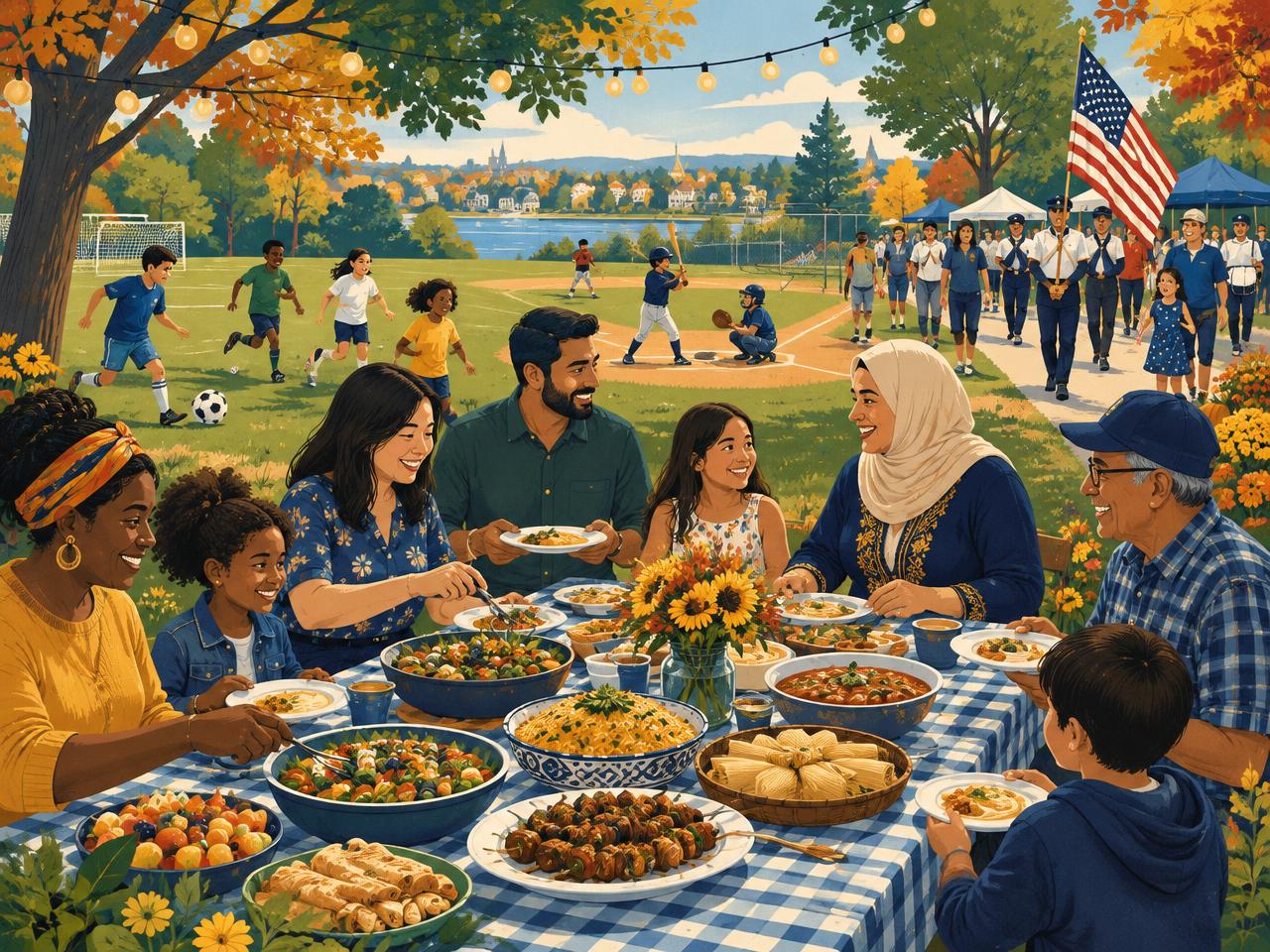
Sharing food is one of the most common ways Americans get together.
- At a potluck, each guest brings a dish to share — a great chance to share food from your own culture.
- "BYOB" on an invitation means bring your own drinks.
- A small gift for the host, like a dessert, flowers, or a drink, is a kind gesture.
- It's common and respected to tell hosts ahead of time about foods you don't eat for religious, health, or personal reasons.
- Some families take their shoes off at the door and others don't. It's fine to ask.
Neighbors and community
Getting to know neighbors and joining local activities helps you feel at home.
- Introducing yourself to neighbors is welcome. Many neighborhoods have online groups, block parties, or homeowners' associations (HOAs) with their own rules.
- Cities have rules about noise, trash pickup days, parking, and yard care. Your city's website explains them.
- Volunteering — at schools, food banks, places of worship, or through national service programs like AmeriCorps — is a common way to connect.
- Parents often join school groups such as the PTA (Parent Teacher Association).
USA.gov: Local governments(opens usa.gov in a new tab)AmeriCorps (americorps.gov)(opens americorps.gov in a new tab)Everyday civic habitsAt work
Workplace customs differ between companies, but a few are common.
- Your employer decides paid holidays and time off. Read your employee handbook or ask human resources (HR).
- Employers generally must make reasonable accommodations for religious practice, such as time for prayer or a holy day, unless it causes undue hardship. Ask your manager or HR.
- Office celebrations, like birthday cakes or holiday parties, are usually optional to join.
- Direct communication is common: people often say what they need and expect you to ask questions when something is unclear.
Shared values
Many Americans describe their shared values with ideas from the founding documents: liberty, equality before the law, government by the people, and rights that belong to every person.
Many also value opportunity and hard work, volunteering and helping neighbors, freedom of religion and speech, and settling disagreements peacefully through voting, courts, and conversation.